THE LITTLE GIRL KEPT DRAWING A RED DOOR AND NO ONE KNEW IT WAS THE ONE HER MOTHER NEVER CAME HOME FROM
On the north edge of Port Lucille, where the marsh grass bent silver in the wind and shrimp boats moved like tired hands across the bay, there was a peeling blue duplex on Marrow Street with one dead azalea bush in the front and a porch that listed half an inch to the left. People passed it every day without seeing much. A widow with too many shifts at the fish packing plant. A little girl who never waved back. Laundry that stayed on the line too long because no one was home in time to bring it in.
The woman’s name was Delia Voss. The little girl was Junie.
Junie was six years old and had the delicate, guarded stillness of a child who had learned that noise did not bring anyone back. She had a round face, a stubborn chin, and a habit of sitting with her knees tucked under her on the cracked linoleum floor by the coffee table. She drew there every evening with the same stubby crayons, most of them broken, all of them worn flat from use.
She did not draw suns with smiling faces or houses with chimneys or stick families holding hands.
She drew doors.
Always the same door.
A red door with a brass knob. Sometimes a step under it. Sometimes a narrow rectangle of yellow beside it, as if light were leaking from a window just out of frame. Sometimes rain slanting down in gray lines. Sometimes a woman with long dark hair standing near it, though Junie never colored the face.
At school, her teacher taped one of the drawings to a bulletin board under the word IMAGINATION. Another teacher said maybe it was a phase. The school counselor asked Delia if Junie had witnessed “a distressing departure event.”
Delia had looked at the counselor’s desk and said, “Her mother left two years ago. That’s the event.”
The counselor had gone quiet after that.
Junie’s mother, Tressa Dane, was the kind of name people in Port Lucille remembered because she had once sung at the harbor festival in a white dress and because she had once vanished so completely that even remembering her started to feel impolite. Some said she ran off with a drifter who worked the oyster routes. Some said she got mixed up with pills. Some said Delia had driven her out, though nobody could explain why Delia would keep every one of Tressa’s old scarves folded in a cedar box if that were true.
The truth, as far as the town knew, was simple enough to fit into a sentence and sharp enough to cut with: Tressa left, and Delia raised the child she left behind.
Delia was not Junie’s mother. She was Tressa’s older half sister by eleven years, broad-shouldered, practical, and too tired for softness most days. When Tressa disappeared, Junie had been four and feverish with an ear infection, asleep on Delia’s couch under a cartoon blanket. By morning Tressa was gone. Her purse was gone too. So was the little silver ring she wore on her thumb. But most of her clothes were still in the closet.
That was the detail Delia never said aloud. People who plan to start over take clothes.
Delia had gone to the sheriff. The sheriff had made a report. Then he had shrugged in that slow local way that meant adult women were allowed to ruin their own lives. There were no signs of struggle. No note. No witnesses worth anything. Tressa had a history of leaving jobs, promises, towns, and men. The case thinned out before the coffee in the station went cold.
Life settled around the disappearance like silt in the bay.
Delia worked. Junie grew. The red door kept appearing.
By the fall of 1998, Junie had stopped speaking much outside what was necessary. Not completely silent. She could answer if she was hungry, if she needed the bathroom, if she wanted the blue cup instead of the yellow one. But her words came as if each one had to be carried by hand from somewhere far inside her. She did not chatter. She did not tell stories. She did not ask many questions.
Except one.
Every few weeks, often at dusk, she would stand by the front window and ask, “Did she find the door yet?”
The first time Delia heard it, she thought Junie meant a dream. The tenth time, she snapped.
“Your mama made her choices.”
Junie had looked at the glass, not at Delia. “But she didn’t come back.”
“No.”
“Then she didn’t find it.”
After that, Delia would close her eyes whenever the red crayon came out.
The child’s silence worried people in practical ways. Mrs. Gant, the school principal, suggested special evaluation. Mrs. Pindle from next door suggested church. Delia’s supervisor, Lou Brees, suggested Delia stop bringing a child’s sadness to work in her face like an extra lunch pail.
But what worried Delia most was not Junie’s silence. It was Junie’s certainty.
The girl did not act abandoned. She acted unconvinced.
That winter, storms rolled in hard off the gulf. Rain rattled the windows and turned Marrow Street into a ribbon of black water and reflected porch lights. One Thursday evening Delia came home late with her hair damp under a plastic hood and found Junie kneeling on the floor with twelve pieces of paper spread around her like cards in a strange private game.
Twelve red doors.
Each one almost the same.
Delia dropped her keys in the bowl by the sink. “Junebug, put those away. Dinner first.”
Junie didn’t move.
“Junie.”
The little girl tapped one drawing with her finger. “This one’s louder.”
Delia stood still. “Doors aren’t loud on paper.”
Junie looked up. Her eyes were dark and solemn. “This one is.”
There were nights when Delia felt as if she were raising a child and haunting one at the same time.
She heated canned soup. Junie sat at the table. Rain pushed at the windows. The old refrigerator hummed and clicked. The whole house smelled faintly of damp socks and celery salt.
“Mrs. Cargill says I need more words,” Junie said suddenly.
Delia put a spoon by her bowl. “You got words.”
“Not the right ones.”
“For what?”
Junie looked down at her soup. “For the red place.”
Delia had no answer for that. She sat opposite the child and noticed how small Junie’s wrists looked above the cuffs of her sweater. She had Tressa’s lashes. Delia hated that some days. Other days she loved it so hard she could barely breathe.
Across town, under the bright pharmacy sign and the flickering movie marquee, life in Port Lucille went on with its usual mixture of gossip and weather and money troubles. Boats came in. Boats went out. At Saint Bernadette Clinic a nurse changed bandages and called numbers. At Harbor Light Elementary, children cut paper turkeys and sang out of tune. At the sheriff’s office, old case files yellowed in steel cabinets.
No one in town had room for one more vanished woman.
No one except the child who kept drawing the same red door.
The first person outside the family to really notice was not a teacher, not a counselor, and not anyone who cared because they were trained to care. It was a county records clerk named Odette Morrow, a narrow-faced woman with amber glasses and the habit of eating saltines over folders in the courthouse basement.
She noticed because Delia had come in on a Friday to request copies of the missing person report again. The sheriff’s office had told her the archive room handled old records now. Delia stood in a work uniform that smelled faintly of fish brine, hair pulled tight, jaw set the way people set it when they intend not to cry in public.
Odette found the file, thinned and ordinary, and slid it across the counter.
As Delia signed the receipt, a folded sheet slipped from her coat pocket and floated down.
Odette bent to pick it up.
It was a child’s drawing.
A red door. Brass knob. Rain.
“That your little one’s?” Odette asked.
Delia snatched it gently but fast. “Yeah.”
Odette hesitated. “Funny thing.”
Delia looked up.
“I process old property transfers too,” Odette said. “I see all kinds of addresses. There used to be a boarding house out off Pelican Causeway with a painted red door. Folks called it the Wren House.”
Delia’s face changed only slightly, but Odette saw it. Not hope. Hope was too dangerous. Just irritation edged with fear.
“You’re saying that because she drew a red door?”
“I’m saying because children fix on odd details.”
Delia folded the paper twice. “A hundred places got red doors.”
“Maybe.”
Delia tucked the drawing away. “Maybe.”
She thanked her, not warmly, and left.
Odette watched her go up the courthouse steps into the wet gray afternoon, carrying a file nobody else thought mattered. She looked down at the blotter on her desk and saw a tiny smear of red crayon where the drawing had touched it.
That night, Junie sat on the floor again and drew the door one more time. Then, with great care, she drew three black birds over the roofline.
When Delia came to collect the crayons, Junie placed her hand over the page.
“Not yet,” she whispered.
“What now?”
“The birds came back.”
Outside, the wind moved through the marsh and made a low hollow sound against the houses, almost like something calling from a long way off.
The next Tuesday, Harbor Light Elementary held Family Reading Hour, which meant folding chairs in the library, stale cookies on paper plates, and adults pretending not to look exhausted. Delia could not get off work in time. She sent a note. Junie sat alone in the back with a book upside down in her lap and watched other children lean against mothers, stepfathers, grandmothers, and one bearded uncle who did voices for every page.
At the far side of the room a volunteer was helping stack returned books into bins. She was new, or at least new to Junie’s eyes. Tall, pale brown skin, silver threads in a long braid, denim jacket with the elbows gone soft. She moved carefully, as if she had once lived in a place where things broke easily and never quite lost the habit.
When the volunteer passed Junie’s chair, a folded paper slipped from Junie’s sweater pocket and fell.
The woman bent to pick it up.
She unfolded it before Junie could stop her.
A red door.
The woman’s fingers tightened.
Junie looked up.
For one suspended second, neither of them spoke. The library seemed to pull away from them, all the noise and chair legs and page turning gone thin and distant.
The woman crouched. “Who drew this?”
“Me.”
The woman glanced at the paper again. “Where did you see it?”
Junie frowned. “I didn’t see it. I know it.”
Something quick and startled moved over the woman’s face. She folded the paper neatly and held it out with both hands, as if returning something important.
“What’s your name, baby?”
“Junie.”
“I’m Elene Barlow.”
Junie took the paper but kept staring.
“Do you know the yellow window?” Junie asked.
Elene’s mouth parted. “What did you say?”
“The yellow window by the door.”
Across the room, Mrs. Cargill called for everyone to gather for the next story. Chairs scraped. A little boy laughed too loud. The spell broke. Elene stood so quickly she nearly knocked over a basket of board books.
Later, when Delia arrived breathless and damp from the evening mist, Mrs. Cargill met her with the cheerful concern school people used when delivering something they thought might become a problem.
“Junie had an odd moment with one of the volunteers,” she said.
Delia’s shoulders tensed at once. “What kind of odd?”
“Oh, nothing improper. Just intense. The volunteer seemed upset by one of Junie’s drawings.”
Delia closed her eyes for a beat. “Of course she did.”
The volunteer was waiting near the rain-dark windows at the front office. Elene Barlow looked older up close than Delia had expected, maybe late forties, with deep lines around her mouth and a steadiness that looked hard-earned. She held a canvas tote against her side as if she might leave any second if pushed.
“I’m sorry to stop you,” Elene said. “Your daughter—”
“My niece.”
“I’m sorry. Your niece showed me a drawing.”
Delia gave the shortest possible nod.
Elene lowered her voice. “I knew a place with a red door and a yellow side window. Years ago. A boarding house on Pelican Causeway.”
Delia’s face shut down. “Half this county knows that place.”
“Not this detail.” Elene hesitated. “There were black birds that nested in the eaves. Grackles mostly. Loud things.”
Junie, standing between them in her little green coat, whispered, “I told you.”
Delia gripped the child’s shoulder, not hard, but enough to say stay here. “What are you actually saying?”
“I’m saying I lived there for three months in 1996. After my divorce. There was a woman there in the spring of ’96, maybe summer. Dark hair. Thin. Bit her thumbnail when she was worried. Sang while she folded laundry.”
Delia went still.
Elene watched her carefully. “I remember because she was sweet to my son when he visited. She called herself Tressa.”
Junie’s hand found the hem of Delia’s jacket.
Mrs. Cargill, sensing live grief in the foyer, retreated toward her office and shut the door with professional softness.
Delia spoke through her teeth. “You should have gone to the sheriff.”
“I did,” Elene said. “A year later, when I saw a flyer in Biloxi with her face on it. They took my statement. No one followed up.”
Delia looked as if she had been struck somewhere she could not show. “Why now?”
“Because your child drew that door exactly.”
Junie stepped forward a little. “Did she find it?”
Neither woman answered.
Outside, rain stippled the sidewalk under the library light. A bus hissed at the corner. Delia’s chest moved shallowly under her work jacket.
Elene said, “I don’t know what happened to her. But I know she was there. And I know something frightened her.”
Delia’s voice turned hard again, because hardness was the only thing keeping her upright. “People always say that after.”
Elene accepted the blow. “Maybe. But she used to stand at that side window and watch the road at night like she was waiting for someone she did not want to meet.”
Junie tilted her head. “The yellow window.”
“Yes,” Elene said softly.
On the walk home Delia said almost nothing. Junie skipped twice to keep up, then fell silent too, reading the weather in Delia’s face the way children read doors before opening them.
At home Delia spread the old missing person file on the kitchen table beside Junie’s drawings. The fish plant smell still clung to her sleeves. She compared dates. Statements. Locations. Gaps. She called the sheriff’s office and got a deputy too young to remember the case.
“Ma’am, if the lead is over two years old, you need to file a supplemental request.”
“My sister might have been seen at a boarding house you never checked.”
“Then you can submit that in writing.”
“In writing.”
“Yes, ma’am.”
Delia hung up before she said something that would make the next step harder.
Junie sat on the floor with a pencil, not drawing this time, just pressing the eraser into the rug over and over.
“Was that her friend?” she asked.
“No.”
“She knew my mama.”
“Yes.”
“Then why didn’t she help before?”
Delia inhaled sharply. Children could ask a thing in eight words and leave no place to hide.
“Sometimes grown folks don’t understand what matters until it’s late,” she said.
Junie considered this. “That’s bad.”
“It is.”
The next afternoon Elene Barlow came to Marrow Street with a shoebox.
Delia had not invited her in, exactly, but neither had she shut the door. They sat in the small front room where the fan clicked and the couch dipped in the middle and Junie always played on the floor where she could see both the television and the front door.
Elene set the shoebox on the coffee table. “I kept old things from that year. Rent receipts. Notes. A postcard. I thought maybe there was nothing useful. Then last night I looked.”
Inside were cracked snapshots, utility bills, envelopes, receipts from a grocery on the causeway that no longer existed.
And one Polaroid.
The image had faded toward orange, but there was no mistaking it. A low weathered house on pilings. Marsh behind it. A red front door. Narrow yellow side window.
Junie leaned so close her breath fogged the glossy square.
“That’s it,” she whispered.
Delia sat down slowly. “Where was this taken?”
“Wren House. Mile marker eleven on the old causeway.” Elene touched the white border without lifting the photo. “It burned down in ’97. Electrical fire, they said.”
Delia’s eyes went to her. “Before or after Tressa disappeared?”
“After.”
Junie traced the air above the red door, never touching the picture. “Was she inside?”
Elene looked at Delia before answering. “Not when I was there.”
That evening Delia drove out to Pelican Causeway with Junie in the passenger seat and Elene in the back. The marsh spread on both sides, black water feathered with reeds, sky low and pewter. The road felt like a strip of memory laid over open water.
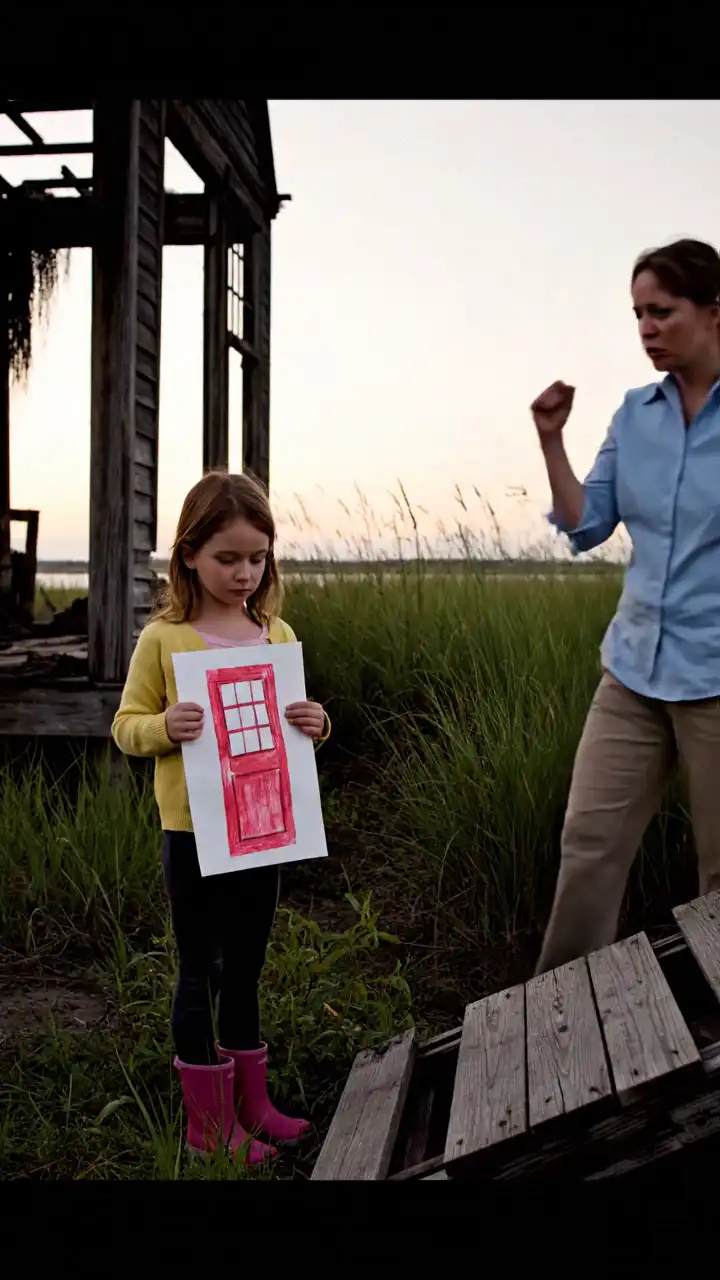
At mile marker eleven there was almost nothing left. A concrete pad. Burned posts like broken teeth. Tangled grass. A mailbox bent sideways and rusted through. Beyond it, marsh and birds and wind.
Junie got out before Delia could stop her.
“Stay close,” Delia called.
The child walked over the wet ground in pink rubber boots, small and certain. She stood where the front steps must have been and turned her face toward the emptiness.
Then she pointed not to the slab, but several yards off to the side where blackberry canes had grown up around a sagging patch of earth.
“There,” she said.
Elene frowned. “That used to be a little shed, I think.”
Delia felt irritation rise, hot and protective, because this was exactly how foolishness began. A child points. A grown woman hopes. Another grown woman remembers poorly. And all of it adds up to a fresh wound.
“We are not digging around a burned property because a six-year-old says there,” Delia said.
Junie did not move. Wind lifted the ends of her hair.
“There,” she said again, barely louder.
Elene wrapped her arms against the cold. “Maybe she just means the outbuilding.”
“She’s six.”
Junie turned then, eyes bright in the gray evening. “She knocked.”
Delia’s whole body tightened. “What?”
Junie looked back at the blackberry tangle. “She knocked and nobody opened.”
Silence spread over the marsh. Even the birds seemed to pause.
Elene whispered, “Delia.”
But Delia was already marching toward the child, anger and fear braided so tight she could not tell them apart.
“Enough,” she said. “We are leaving.”
Junie flinched, not from volume but from the flatness of it. Delia took her hand and led her back to the truck. Junie did not resist. She only looked over her shoulder until the darkness swallowed the place.
That night, after Junie was asleep, Delia sat at the kitchen table while Elene stood at the sink with cold coffee gone untouched between them.
“I shouldn’t have brought her,” Delia said.
“No.”
“She hears one thing, she sees one old picture, and now she thinks she knows.”
Elene’s voice was careful. “Maybe she knows in the way children know. Sideways.”
Delia laughed once, without humor. “No offense, but sideways is how women like my sister go missing while men file papers.”
Elene was quiet. Then she said, “I lost a son.”
Delia looked up.
“He died at eight. Asthma attack in a storm when the roads were flooded.” Elene clasped her own hands tightly. “For a year afterward, I would swear I heard him cough from the back room. I thought grief was making a fool of me. Maybe it was. But grief can also sharpen what the world wants you to ignore.”
Delia did not answer.
From the bedroom, Junie’s small voice drifted down the hall, half asleep.
“Don’t leave her outside.”
Both women turned.
Neither moved for a long moment.
The next morning Junie refused school.
She did not throw a tantrum or cry. She simply sat on the floor by the front door in her coat with her backpack on and her crayon box in her lap and said, “Not today.”
Delia, who had exactly fourteen minutes before she had to be in her truck for the first shift, stared down at her. “You are dressed for school.”
Junie nodded.
“Then get up.”
“No.”
“You can’t just not go because you feel like it.”
Junie opened the crayon box and took out the red one. “I have to show her better.”
Delia rubbed her forehead. “Show who?”
“The lady with the braid.”
“Elene is not coming today.”
Junie placed a sheet of paper on the floorboards and began drawing right there by the threshold, using the heel of her hand to hold the page flat. Red rectangle. Brass knob. Yellow window.
Then, for the first time, she drew what was beneath it.
Not a stoop.
Not flowers.
Not the whole house.
She drew crooked boards on the ground, brown and crossed, and beside them a square shape with dark lines under it.
A hatch.
Delia stared before she could stop herself.
Junie added three short marks on the red door.
Knock knock knock.
Her own pulse went strange.
“Who told you that?” Delia asked.
Junie shrugged without looking up. “Nobody.”
Delia crouched. “Then where did you see it?”
Junie pressed harder with the crayon until it snapped. She looked at the broken wax in her fingers as if surprised by it.
“In the loud picture,” she said.
Adults liked neat evidence. A statement. A map. A date. Something that could be entered into a system and retrieved by drawer number. What Junie had was repetition, pictures, and a stubborn instinct attached to a place no longer standing. It was the kind of thing sensible people stepped away from.
Unfortunately, sensible people had not found Tressa Dane.
By noon Elene was back at Marrow Street with a county plat map borrowed from Odette Morrow and a thermos of coffee. Delia had called in sick for the first time in eight months.
The three of them sat on the floor around the coffee table while rain tapped the windows and the television muttered low with the sound off.
“This was the main structure,” Elene said, pointing to the map. “And this little square behind the side yard may have been storage.”
Junie pushed her own drawing beside it. “That.”
Delia crossed her arms. “It could be anything.”
“Yes,” Elene said. “But the boarding house owner, Len Pardue, was cited once for an unpermitted root cellar after a storm. Odette found the note in an old tax file.”
Delia looked sharply at her. “You already checked.”
“I started after the library.”
That annoyed Delia, though she could not say why exactly. Maybe because Elene had moved before she had. Maybe because hope was easier to manage when it belonged only to you.
“We are not going out there with shovels,” Delia said.
Junie, still sitting cross-legged, spoke into her own drawing. “You don’t need shovels first.”
Both women looked at her.
Junie set down the crayon. “You need the boards.”
“What boards?” Delia asked.
“The boards over the square.”
“Junie,” Delia said carefully, “this is not a game.”
Junie finally looked up. Her expression held no child’s playfulness, only urgent frustration. “I know.”
The wrong-looking method began that afternoon because no official person would help and because Junie would not stop.
She would not eat unless the paper stayed on the table. She would not nap. She followed Delia from room to room carrying the drawing by one corner until it bent soft in the middle. Every time Delia tried to redirect her, Junie repeated the same thing.
“Three knocks.”
Later: “Not the front.”
Then: “Side yard.”
Then, almost in tears from the effort of dragging words into shape: “She was under the boards.”
By evening Delia’s resistance had changed shape. She no longer dismissed the child. She feared her.
Not because she thought Junie was wrong.
Because some deep part of her had started to think the girl might not be.
The sheriff’s office refused to send anyone based on what Deputy Harlan called “a child’s imaginative impression of a demolished site.”
“Ma’am, if you have material evidence, bring it in.”
“I’m trying to get material evidence.”
“Then do that.”
So at sunset Delia drove back to Pelican Causeway with Elene beside her and Junie in the back seat hugging the shoebox of papers to her chest like a witness packet.
The marsh smelled of wet grass and salt rot. Wind pushed low clouds east. The old Wren House lot looked even emptier in the fading light.
Delia carried a flashlight. Elene brought a rake and work gloves from her car. It all felt ridiculous enough to be embarrassing and serious enough to make Delia’s hands shake.
“You stay by me,” she told Junie.
Junie nodded but the minute they stepped into the side yard, she pulled Delia not toward the concrete slab but toward the blackberry tangle again.
“There.”
The canes scratched their jeans and caught at sleeves. Elene used the rake to drag them back. Beneath the growth, the ground dipped where something once had been. Half-rotted planks lay collapsed over a dark square depression clogged with leaves and ash-black dirt.
No one spoke.
Junie’s breathing was suddenly loud in the small space.
Elene whispered, “Oh God.”
Delia knelt and brushed mud from one board with her bare palm. It was old, softened by weather, but arranged in an unnatural crosshatch as if placed there in a hurry long ago and then forgotten beneath ruin and growth.
Junie gripped Delia’s shoulder. “Three knocks.”
Delia swallowed. Then, because refusing the child now seemed somehow crueler than obeying her, she made a fist and knocked three times on the top board.
The sound was dull, hollow.
Not ground.
Space.
Elene stepped back so hard she nearly lost balance in the weeds. “Delia.”
Delia knocked again. Same hollow answer. Her face drained of color.
Junie crouched and laid one small hand flat on the wood. “She heard that.”
A reasonable person would have taken the child back to the truck immediately. A reasonable person would have marked the site and waited for authorities. But reason had failed this family for two years. It had filed reports, shrugged, and gone home for supper.
Delia slipped her fingers under the edge of the nearest plank. It came up with a sucking sound from the mud.
Under it was darkness and the smell of trapped damp earth.
Elene covered her mouth.
They did not open the whole thing. Delia was not thinking clearly enough to do that and not thinking badly enough either. She saw, in the beam of the flashlight, a rusted metal ring set into a square wooden hatch beneath the loose planks.
A cellar door.
A hidden one.
Junie started to cry, but very quietly, as if she had expected sadness and was only relieved it had finally arrived somewhere she could touch.
Delia stood so fast she dropped the flashlight. “Back to the truck. Now.”
“What is it?” Junie whispered.
Delia picked up the light with clumsy fingers. “Back to the truck, baby.”
Elene was already moving, fumbling for her car phone, though reception out there was weak and patchy. She climbed onto the causeway shoulder, searching for a signal and raising the antenna by hand.
Junie held onto Delia’s jacket. “Did she find the door?”
Delia looked down at the hidden hatch, then at the child. Her mouth trembled before she got control of it.
“No,” she said. “I think she was trying to get out.”
The deputies arrived forty minutes later with two cruisers, one floodlight, and the expression men wear when they have been called to a place by women they assume are overwrought. Deputy Harlan looked at the boards, the hatch, the three of them muddy to the knees, and tried to keep skepticism in place.
“Who located this?”
Delia’s hand rested on Junie’s hair. “She did.”
He almost rolled his eyes. Almost.
Then he knocked on the wood himself. Hollow.
The fire department came with pry bars. The scene grew bright and official under portable lamps. Wind flattened the marsh grass. Junie sat wrapped in Elene’s denim jacket in the back of Delia’s truck and watched men work around the place she had drawn for months.
When the hatch was lifted, stale air breathed out from below.
One of the firefighters swore under his breath.
A narrow cellar, hardly more than a pit with shelving, rainwater stains, mold, broken jars, debris from the fire collapse above.
And among it, caught in the silt at the far wall, the faint pale curve of bone.
Delia made a sound Junie had never heard before. Not a cry. Not a word. Something lower and more broken than either.
Elene turned Junie’s face into her coat before the child could see more. But Junie had already seen enough in the adults to understand the shape of it.
“She was there,” Junie said into the denim.
No one answered her.
The site became a crime scene at last, years too late. Tape went up. Men wrote notes. A county investigator was called from Bay Terre. Odette Morrow appeared an hour later because Harlan had mentioned the archived citation and she refused to stay home once she understood. She stood by the floodlight with her hand over her heart, staring at Junie as if the child had opened the ground herself.
Deputy Harlan approached Delia near midnight. His voice had changed. “Ma’am, we’re going to need dental records if possible. Personal effects may help.”
Delia looked toward the open cellar, lit white in the rain mist. “She wore a silver thumb ring.”
He nodded grimly. “We found one.”
Junie slid from the truck before anyone could stop her. She walked across the muddy yard in her boots until she stood a few feet from the tape.
Delia reached for her. “Junie, no.”
But the girl lifted her hand toward the dark opening and whispered the line she had been carrying for two years.
“I found the door.”
Every adult there went still.
The wind moved over the marsh, lifting the yellow tape in brief shivering waves. Somewhere in the black reeds, birds rose suddenly and scattered.
After the cellar was opened, Port Lucille changed its story.
That was one of the ugliest things Delia ever learned: people could hold one version of a woman for years and replace it overnight, not because they had become kinder, but because bones forced them to. By the next afternoon the diner on Wharf Street was full of lowered voices and widened eyes. Tressa Dane was no longer the woman who had run off. She was the poor thing from the causeway. The girl on the harbor stage. The one in the cellar.
It should have comforted Delia, this reversal. Instead it made her furious.
Where had all that tenderness been when Junie cried for a mother everyone insisted had chosen to leave?
The sheriff’s office called it a reopened investigation. The county paper called it a shocking discovery. The radio station called it a cold case break led by a child’s drawing, and then softened the phrase to concerned family persistence because no one wanted to sound like they believed in anything they could not file.
But in the blue duplex on Marrow Street, the real change was quieter and harder.
Junie began to speak.
Not all at once. Not in some magical flood. The miracle did not come as noise. It came as release.
The first morning after the causeway, Delia found her at the kitchen table with a clean sheet of paper. The red crayon lay untouched beside her. Junie was drawing with blue.
Waves.
Only waves.
No door.
Delia stood in the doorway, hands damp from the dishwater, and watched without interrupting.
Junie looked up. “It stopped.”
“What stopped, baby?”
“The loud.”
Delia had to grip the back of a chair. “You mean in the picture?”
Junie nodded.
Delia moved carefully, as if coming near a hurt bird. “What do you hear now?”
Junie considered. “Nothing bad.”
Then she added, with childlike practicality, “I’m hungry.”
Delia laughed and cried at the same time, which scared Junie for half a second until Delia wiped her face and said, “That’s all right. That’s a good thing. You want eggs?”
Junie nodded. “And jelly toast.”
At school, Mrs. Cargill called Delia into the office after only three days.
“I don’t know how to phrase this professionally,” she said, lowering herself into the chair behind her desk. “Junie raised her hand in class.”
Delia blinked.
“She answered questions. Volunteered a whole sentence during reading circle. Then she corrected another child about seagulls and grackles.”
Delia almost smiled. “Well. She would.”
Mrs. Cargill folded her hands. “I was wrong about her.”
“Yes,” Delia said.
The principal flushed. “I mean I thought withdrawal was the primary issue. But it may have been something more focused. A burden.”
Delia looked through the office window at children crossing the playground in two crooked lines. “She was carrying something nobody believed.”
Junie’s teacher started sending home little notes.
Today Junie told us marsh birds sleep standing in the reeds.
Junie drew a whole boat.
Junie asked if windows can remember faces.
That last note Delia tucked into the cedar box with Tressa’s scarves.
The reopened investigation began turning up details that looked small on paper and monstrous in the heart. Wren House had been owned by Len Pardue, dead now from liver failure. He had run rooms cheap and asked few questions, a skill often admired in poor counties until it became evidence of something darker. Another tenant remembered shouting one stormy night. A truck with one headlight out. Tressa seen at the side yard after midnight. No confirmed witness after that.
There was enough to suggest she had tried to hide from someone in the root cellar and never gotten out. Enough to suspect someone had dropped planks over the hatch in panic or malice. Enough to know she had not abandoned her child.
Not enough to charge a dead man. Not enough to convict the living one the investigators eventually identified as a drifter named Wade Selby, who had vanished west after a bar fight in ’97 and might himself have been dead in Texas for all anyone knew.
The law was uncertain.
The child was not.
Junie listened from hallways and grocery store aisles and the back seat of Delia’s truck. Adults began lowering their voices when she entered, which only taught her that truth made people clumsy.
Elene Barlow came often now. At first she arrived with practical offerings—soup, school pencils, a can of paint for the porch rail—because people who had lost children knew grief often needed a bag of groceries more than a speech. Then she came without offerings too, just to sit at the table while Junie colored and Delia sorted papers for the investigator.
No one named what was happening between them. It began in ordinary acts.
Elene fixed the loose screen door.
Junie started waiting for her on Thursdays.
Delia, who trusted almost nobody, gave Elene a house key “for emergencies,” then resented how relieved it made her feel.
One Saturday, while Delia scrubbed the tub and the radio murmured weather reports, Junie climbed onto a kitchen chair beside Elene and spread out fresh paper.
“What now?” Elene asked.
Junie held up the red crayon, then set it aside and chose green.
“A yard,” she said.
Elene watched as Junie drew the blue duplex on Marrow Street. Crooked porch. Dead azalea. Two windows. Then, after a pause, she drew three people standing in front.
A broad woman in a work shirt.
A small girl.
A taller woman with a braid.
Elene looked at the page and then at Junie. “That me?”
Junie nodded.
Delia, listening from the bathroom doorway with a rag in her hand, went very still.
Elene smiled carefully. “I don’t live here.”
Junie kept drawing. “You come here.”
“That’s true.”
Junie added a fourth shape, smaller and low to the ground. A dog, though they did not own one.
“What’s that?” Elene asked.
“The next thing,” Junie said.
Children sometimes said things that meant nothing and then made them true by accident. Three days later, a one-eyed stray hound followed Junie and Delia home from the corner store and refused to leave their porch. Junie named him Bucket because he had walked with his head stuck briefly in an abandoned bait bucket before Delia rescued him.
Even Delia had to laugh at that.
The house changed with these small invasions. A dog bowl by the sink. Elene’s mug beside Delia’s. Junie’s drawings taped not only to the fridge but along the hall, their subjects widening into boats, birds, porch steps, faces. She still drew doors now and then, but open ones.
Still, adults resisted the shape of the miracle because miracles were easier to admire than accept.
When the county investigator, Malcolm Reeve, visited to ask follow-up questions, he sat at Delia’s kitchen table with legal pads and a face arranged into careful neutrality.
“We appreciate that the child led you to the outbuilding site,” he said.
Delia folded her arms. “The child led us to the hatch.”
“Yes. Though I’d caution against framing her impressions in ways that might influence future memory.”
Junie sat on the floor nearby, clipping coupons into little squares because she liked the neatness of it. She looked up. “I wasn’t remembering. I was telling.”
Reeve gave the polite adult smile reserved for impossible statements from small people.
Delia’s voice chilled. “You hear that?”
“I do.”
“Then write it down right.”
He wrote something. Delia doubted it was right.
After he left, Junie crawled into Delia’s lap though she was getting a little too big for it. “He thinks I made it up.”
Delia wrapped both arms around her. “A lot of grown folks do that when they’re scared.”
“Of what?”
“That a child saw what they missed.”
Elene, standing at the sink washing cups, looked over her shoulder then. The expression on her face held grief and admiration in equal measure.
The public discovery came two weeks later in the fellowship hall of First Pilgrim Church, where Tressa’s memorial was held because no body should come home to Port Lucille without someone finally saying her name kindly in a room full of witnesses.
The church smelled of lemon polish, lilies, and damp hymnals. People filled the pews in funeral black and fishing jackets and work uniforms. Women who had once repeated ugly rumors now cried into tissues. Men removed their caps and stared at their hands.
On the easel by the altar stood the only enlarged photograph Delia had of Tressa laughing, head thrown slightly back, eyes closed.
Junie wore a navy dress with a white collar and shiny shoes she hated. She sat beside Delia and Elene on the second pew, swinging one foot until the organ started.
The preacher spoke of lost sheep and hidden things brought to light. Delia barely heard him. She heard instead every time Tressa had sung in the kitchen, every slammed cabinet from those final months, every official shrug.
Then the preacher said, “There is someone small among us who would not let this truth stay buried.”
Heads turned.
Delia stiffened. She had not agreed to this.
The preacher smiled gently toward Junie. “No, child, you needn’t come up. But we honor the one who kept drawing the door.”
A rustle moved through the church.
Junie froze, overwhelmed by the weight of all those faces. Delia felt her body lock against her side. Before panic could take hold, Elene leaned down and whispered, “Just breathe. I’m right here.”
Junie nodded once.
From the back pew, old Mrs. Pindle began to cry openly. Then Odette Morrow. Then one of the harbor men who had known Tressa as a teenager.
It was not the speeches that changed the room. It was the sight of Junie reaching into the folder in her lap and pulling out one of the old drawings. She held it against her chest, not up for display, just close.
And in that packed church, people saw at last what Delia had lived with for two years: the child had been trying to hand them the truth in red wax and they had called it damage.
After the service, strangers came with soft voices and casseroles and apologies shaped like compliments.
“She’s a special little thing.”
“Children know more than we think.”
“Bless her heart.”
Delia accepted none of it fully. Still, she let them speak, because Junie listened. The child needed to see the town bow, even awkwardly, to what it had ignored.
Outside under the oaks, as mourners drifted toward cars, Junie looked up at Delia.
“Can I say bye now?”
Delia crouched. “To who?”
“My mama.”
The question should not have broken her, but it did.
Delia touched the white collar straight. “Yes, baby.”
Junie turned toward the church steps, where the late afternoon sun had struck the red-painted side door of the fellowship hall so brightly it almost glowed.
She lifted one hand in a solemn little wave.
“Bye,” she said. Then, after a moment, “I got you.”
Elene covered her mouth and looked away.
Delia could not. She sat right there on the church walk and gathered Junie into her arms while people passed around them in respectful silence, and for the first time since Tressa disappeared, Delia cried without anger mixed into it.
The final truth did not come from the cellar.
It came from a drawing no one had understood.
Two days after the memorial, Odette Morrow drove to Marrow Street with a county archive box on her passenger seat and urgency in her usually measured face. She knocked so fast Delia thought at first something was wrong with Junie at school.
Instead Odette held up a laminated flood map from 1996 and said, “I need to see the child’s old pictures.”
Delia, hair still damp from a rushed shower before the late shift, stared. “Why?”
“Because I think the door wasn’t the only clue.”
Junie was in the living room on the floor with Bucket’s head in her lap. She looked up as Odette came in, serious as a judge and just as eager.
“Your bird drawings,” Odette said gently. “Do you still have them?”
Junie pointed to the hall where Delia had stacked old pages in two grocery bags.
For nearly an hour the three women and one child sat amid a scatter of paper. Doors. Birds. Rain. Window light. More doors. In some, three black birds over the roofline. In others, not birds exactly but shapes like bent V’s. In one, the birds seemed lined up along a wire. In another, one black mark sat lower, near the side yard.
Odette spread out the flood map.
“In spring of ’96 the utility company moved a line post on Pelican Causeway after storm damage,” she said. “I was checking right-of-way permits this morning for another case. The old line used to run over the Wren House side yard. Three birds on the wire would have looked exactly like this from the front stoop.”
Delia leaned over the map. “And?”
Odette tapped a tiny square marked SERVICE SHED. “The lower mark near the yard may not be a bird. It could be the warning plate on the shed post.”
Elene, who had joined them halfway through with coffee and then forgotten to drink it, frowned. “So what?”
Odette looked at Junie’s pages, then at Delia. “So if Tressa stood on the stoop and looked toward the side yard, these repeated marks might mean she kept seeing something there. Someone there.”
Delia’s breath shortened. “A truck?”
“Maybe. Or a man waiting near the shed. Something she feared.” Odette flipped through the archive box and pulled out a copy of an old insurance photograph taken after minor storm damage months before the fire.
There it was: Wren House front elevation. Red door. Yellow side window. Utility line overhead. Three dark birds perched on the wire.
And at the edge of the frame, barely visible near the shed, a one-headlight pickup with a crooked primer-gray fender.
Elene grabbed the photo first. “That’s the truck I remember.”
Odette nodded. “A tenant complaint mentioned a visitor’s truck blocking the yard. The plate was partly logged in the property insurance file because it obstructed the damage view. Last four digits only, but enough for the investigator to work from if they can match local records.”
Delia sat down hard on the couch.
Junie looked from face to face. “The birds were showing.”
No one corrected her.
Investigator Malcolm Reeve returned that evening and, for once, did not wear skepticism like a clean shirt. He sat at the kitchen table with the photo, the map, and Junie’s drawings lined up in order of date. He asked where each had been found, when each was drawn if Delia knew, and whether Junie had ever described the black marks before.
“She said they came back,” Delia answered.
Reeve looked at Junie. “Did you mean the birds?”
Junie shook her head. “The looking.”
The investigator stopped writing.
Elene whispered, “Lord.”
Reeve tried again. “Looking from where?”
Junie pointed to one drawing where the faceless woman stood near the yellow window.
“From in there,” she said. Then she moved her finger to the black marks over the yard. “At him.”
Delia’s hand flew to her mouth.
For the first time, Malcolm Reeve looked less like a county official and more like a man standing at the edge of something he could not explain but no longer dared dismiss. He gathered the documents with extraordinary care.
The partial plate led to an old registration file in Jackson County. The truck had belonged to Wade Selby after all. More importantly, a retired mechanic remembered replacing one headlamp and the primer-gray fender after Selby hit a culvert in June of ’96. The dates aligned. Selby had been at Wren House repeatedly that summer.
That did not bring a trial. It did something stranger and, for Delia, almost as necessary. It brought a narrative that could no longer be twisted into abandonment.
Tressa had not walked out on her child. She had been trapped in fear before she was trapped under boards.
When the investigator returned with the update, he asked to speak to Junie too. Delia bristled, but Junie nodded solemnly and climbed into the armchair with Bucket under her feet.
Reeve knelt to be eye level.
“I was wrong,” he said.
Junie waited.
“I thought your pictures were just pictures.”
She touched the arm of the chair. “They were pictures.”
He almost smiled. “Yes. They were also more.”
Junie considered forgiving him. “You can look better now.”
He bowed his head once, accepting the instruction.
The most important witness to the truth, though, was not the law. It was Delia.
That night after everyone left, she took down the oldest drawing from the refrigerator door, the one Junie had made nearly a year before with the red rectangle too thick and the yellow window almost gold. She set it beside the insurance photograph on the table.
Same angle. Same line of birds. Same side yard.
She sat for a long time in the dim kitchen while Junie slept and the dog snored and the house settled around her in soft pops and creaks. She remembered all the times she had told Junie enough, stop, not now, put that away. All the times she had tried to save the child from the story when the child had in fact been carrying the key to it.
When Elene came by late to drop off a casserole dish, she found Delia still there.
Delia didn’t look up. “I kept asking why she wouldn’t let it go.”
Elene set the dish down quietly. “Because her mama hadn’t come home yet.”
Delia nodded, tears finally falling fresh. “And I kept thinking I was protecting her.”
“You were,” Elene said. “Just not from the right thing.”
In the bedroom, Junie stirred and called out, half asleep, “Delia?”
Delia wiped her face and went in at once.
The room was lit only by the night-light shaped like a moon. Junie sat up with her hair mussed around her face.
“Bad dream?” Delia asked.
Junie shook her head. “No. Just checking.”
“Checking what?”
Junie held out one hand from under the blanket. “You.”
Delia sat on the edge of the bed and took it. “I’m here.”
Junie’s fingers tightened. “You stay.”
“I stay.”
The child studied her, then whispered the sentence that undid the last hard knot in Delia’s chest.
“I knew she didn’t leave me.”
Delia bent over, pressing her forehead to Junie’s small hand. “I know,” she said. “I know now.”
Spring came early to Port Lucille that year.
The azalea bush in front of the duplex, long presumed dead, surprised everyone by pushing out three stubborn pink blooms from one cracked branch. Junie announced this as if she had personally negotiated it.
“See,” she told Bucket. “It wasn’t done.”
The county never solved every piece of Tressa’s death. Some stories remain ragged at the edges, even after the center is found. But the worst lie was gone. In its place stood a different inheritance for Junie: not abandonment, but love interrupted by violence.
That changed the child from the inside out.
She laughed more. Not constantly, not unnaturally. Just enough that the house learned her sound. She spoke in school and came home with paint on her sleeves and questions about pelicans and tides and why adults throw away jars that can still hold things. She stopped drawing the red door every day. Then every week. Then only once more, on the anniversary of the memorial, when she drew it wide open with bright marsh grass beyond.
Delia framed that one.
The biggest change arrived on a humid Saturday in May when Elene Barlow came over with a pound cake and found Delia repairing the porch step while Junie sat nearby wearing a bathing suit under her dress because she expected water play to happen at any time if she remained ready.
“Elene,” Junie said, as if continuing an earlier conversation. “You should move here.”
Elene laughed. “That’s a big suggestion.”
“You already got a key.”
Delia straightened slowly from the porch board, hammer in hand. Heat rose in her face, which annoyed her because she was too old to blush over truths a six-year-old had spotted first.
Elene looked from Junie to Delia. “That so?”
Junie nodded. “You’re in the yard picture.”
Silence held for one long, living moment. The neighborhood buzzed with cicadas. Somewhere down Marrow Street a screen door slapped.
Delia set the hammer down.
“I don’t know about moving in,” she said carefully. “But maybe staying more wouldn’t be the worst idea.”
Elene’s eyes softened in that quiet way Junie trusted from the first day in the library. “Maybe not.”
By the end of summer, “staying more” had become most nights. Elene’s apartment across town emptied into boxes, then into the spare room, then into drawers and hooks and the bathroom shelf where her hair ties collected in a bright little dish. Nobody made a ceremony of it. That was not how this family formed. It formed by repetition, by dinner plates, by shared rides, by the simple miracle of someone continuing to come back.
People in Port Lucille called it what they liked. Companion. Boarder. Friend. Auntie. Delia let them. Junie solved it in her own language.
At Harbor Light’s fall family picnic, when another child asked who the lady with the braid was, Junie replied, “She’s one of mine.”
The child accepted this instantly. Children often understand kinship better than adults.
One evening in October, after catfish dinner and homework and a bath battle involving too many toy cups, Junie curled between Delia and Elene on the couch while Bucket snored at their feet. Wind rattled the loose screen door that Elene kept meaning to rehang.
Junie held a fresh piece of paper on her knees.
“Another one?” Delia asked.
Junie nodded.
She drew slowly, tongue peeking from the corner of her mouth with concentration. Not a red door this time. A porch. Three figures. A dog. The azalea bush with pink blooms. Above the house she made a wide blue sky and no birds at all.
When she finished, she held it up.
“What’s this called?” Elene asked.
Junie leaned back against them both, satisfied.
“Home,” she said.
Delia put an arm around her. Elene did too. The child settled deeper into the space they made without needing to ask if it would hold.
Outside, Marrow Street lay quiet under the porch lights. The marsh wind moved through town carrying salt and water and the far-off horn of a boat heading in. Inside the little blue duplex, the missing piece had changed shape. It had not vanished. Some losses never do. But it no longer lived like an open wound in the middle of the floor.
It had become a door finally opened.
And the child who kept drawing it was no longer trying to bring the dead back through it.
She had led the living home instead.
Aviso: La mención de cualquier marca o logotipo es solo con fines de identificación y no implica asociación ni respaldo